Archive for the ‘Arena Construction’ Category

Why Our Footing Cannot Be Mixed With Your Footing

February 1, 2016

Around this time of the year, customers are planning their spring barn projects causing our number of inquiries to rise; along with how many questions we get about our footings. Recently, we’ve noticed a few popular questions come up, with the most popular being: “what do I do with my old footing? Can yours be mixed in?”

Our footing is manufactured in a specific mixing facility in Upstate NY. This allows for us to control all aspects of the environment that the mixture isArena Footing cannot be mixed,  being created in. If we did not so closely monitor the manufacturing process, the footing could end up with particles in the footing that create dust, or an incorrect type of sand in the footing, which could cause the footing to compact. We have kept the same formula for our footing since we started in 2004, and do not want to alter it in anyway.
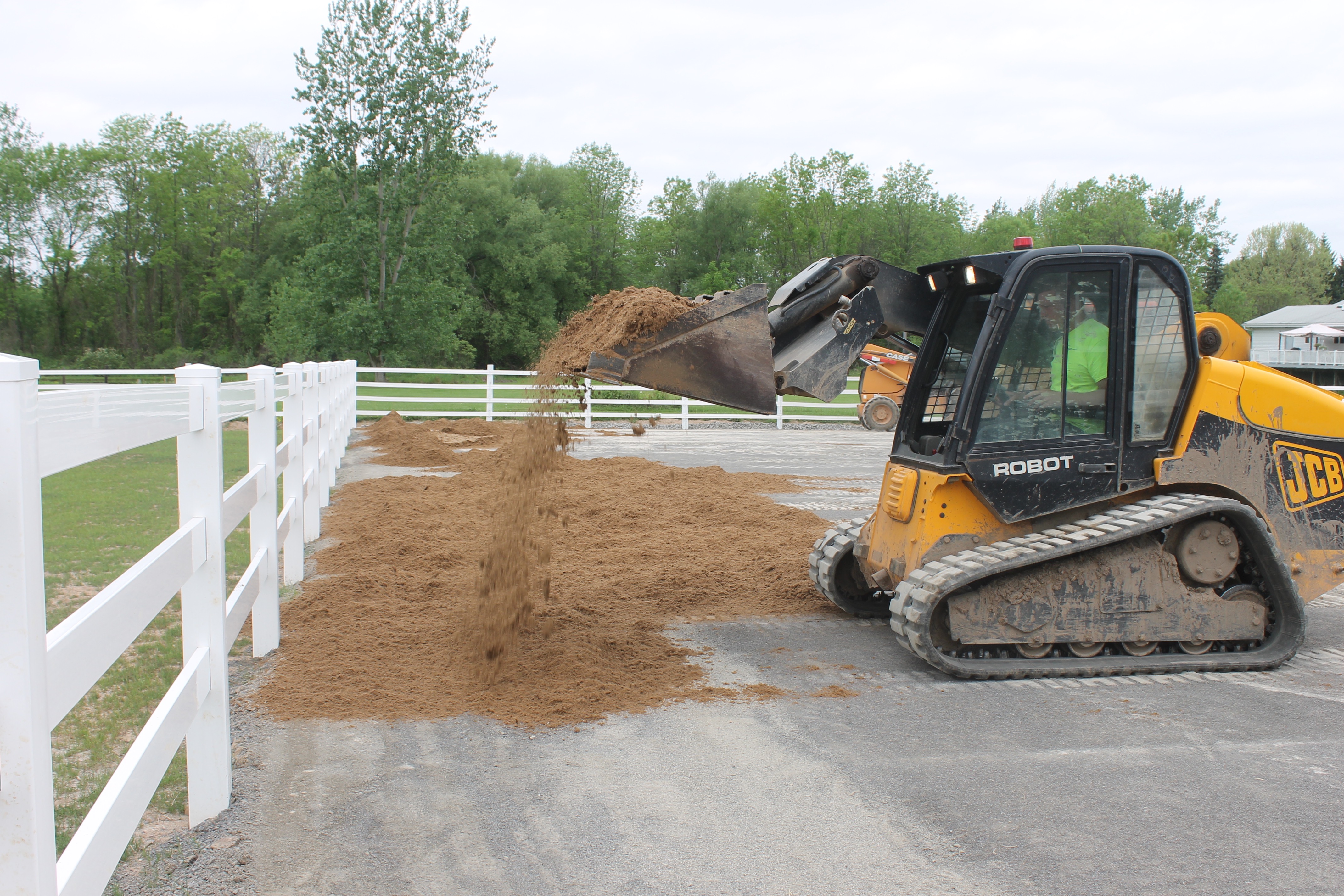
With our footing being manufactured in such a specific way, there is not an alternate approach for making our footing such our footing to be mixed in with what is currently in your arena. If you have a current arena with footing, it will have to be completely removed in order to install our products. The most common approach for removing footing is to hire a contractor that has worked with horse arenas before. It is important to check references before the contractor starts work. The footing has to be removed in such a way that it does not damage the base. More than likely, a bit of base work will have to be done before adding our dust-free footing.

We love all of the questions that we get asked and if you have any questions I may have no answered in our blogs, let me know!

Breaking Down the Recipe of our Footing

October 5, 2015

We get many questions about what our footing is made up of so I thought I would take a few minutes and explain the components of our footing and why we use such components. Each of our footings has their own special formula. (I’m not going to give you the secret recipe though, sorry!) Let’s take a look at what’s inside.

Our TruStride footing is composed of rubber granules, synthetic fiber blend, wax and pure silica sand. LiteStride is made up of a synthetic fiber blend, wax and pure silica sand. The new Equi-Blend footing has the same components as LiteStride, but less fibers and less wax, which minimizes the cost. And our 5K Ranch footing is composed of pure silica sand and wax.

Let’s start with explaining our rubber granules. The rubber comes that we get comes from a factory that manufactures shoes. When shoes soles are created, there is a mold that they are in, once the shoes soles are cut out, there is excess material that is considered a waste to this factory. This waste is ground up and delivered to us as small rubber granules, making this 100% recycled post-industrial material. We chose to add rubber granules to our TruStride footing to give it the extra cushion needed for high jumping disciplines, busy barns, or thoroughbred tracks.

Our synthetic fiber blend that we use is made up of premium recycled fibers also making this ingredient a 100% recycled post-industrial material. We chose to use synthetic fibers because they do not break down over time. The fibers in our footing create a lattice like effect, holding the footing together and allowing it to “give” a little while still creating a stable surface.

The most important components of our footings, and what keeps it dust free is our wax that we use. There are plenty of otherIMG_0897 options that are used in footings to coat the material and keep it dust free, both natural and synthetic.  The logic behind this choice was the longevity of wax. Our oldest footing is 14 years old and is still going strong. Wax does not break down and decompose like other binders.  It is a top of the line wax that we have never had a problem with and love working with!
The pure silica sand is the last but not the least. We have spent a lot of time finding the perfect sand for our blend. The sand that we chose is subangular sand. Normal sand has lots of different shapes and angles. When this type of sand is put into an arena, the sand angles on the sand particles will eventually be worn down, creating dust in your arena, and also causing your surface to not be as stable as it once was. Subangular sand has been partially worn down so that there are some small angles but most of it is rounder. By using sand like this, the smaller angles allow the sand to get nice and tight together while still allowing room to move. It creates the perfect stability that we wanted for our footing.

We’ve spent many years in research and development before we came to have the perfect recipe for our footing. That’s why our footing is the best dust free footing on the market! Feel free to contact us and ask for a sample so you can visualize the different components that are used.

Retaining Boards in Arenas

September 21, 2015

Let’s talk about outdoor arenas. What is your biggest issue with your outdoor arena? Outdoor arenas are trickier to build and maintain than an indoor, for the fact that you are working against Mother Nature. An all-weather horse arena needs to be designed and constructed to deal with the many different weather conditions that Mother Nature may send your way. Having a traditional sand arena during these situations can make the fight even harder.

I think there are many aspects of outdoor arenas that are overlooked when building, then by the time you are done you wished you had done something differently. One of the biggest, minor things that I think is overlooked is the importance of retaining boards in an arena.

Retaining boards are very critical to an arena. They have the job of holding the footing in the arena, and stopping it from migrating into the drainage outside of the arena or grass. Many times, without using a retaining board, footing is pushed to the outside every time the arena is groomed. During this instance, customers have to replenish their arena every few years because of footing loss into their yard. Along with keeping the footing in the arena, retaining boards also create a nice clean boarder around the arena. This will stop grass from growing in the arena, and make it easy to maintain and mow the area around it.

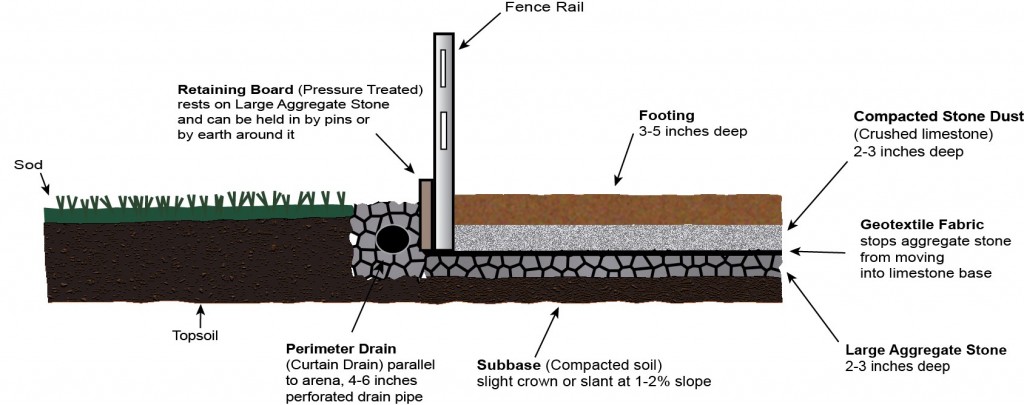
Just below, you can see a graphic of a side view of how arenas should look. Your base should be about 2-3 inches of large aggregate stones, with 2-3 inches of compacted stone dust on top of that. Your retaining board needs to sit on the outside of your fence posts, directly on top of the aggregate stone. The retaining board can be held in place by the aggregate stone drainage on the outside of the arena, or you can install pins in the boards to hold it in place. The top of the board should be about 1-2 inches above your footing in order to stop the footing from escaping the arena.Footing Side View

IGK Equestrian has spent years studying and researching the best ways to build both outdoor and indoor arenas. We have driven or flown out to see customers, whether an hour away or across the country many times to help them with the installation process of their arena, and we can come to your arena for a consultation at any time, just call us up or send us information online! Our dust-free footings are the perfect addition to your arena installation. With never having to water the arena and less time on maintenance, you have more time to ride and train your horses.

Is there something you wish you did differently when installing your arena?