Archive for the ‘Arena footing’ Category

Retaining Boards in Arenas

September 21, 2015

Let’s talk about outdoor arenas. What is your biggest issue with your outdoor arena? Outdoor arenas are trickier to build and maintain than an indoor, for the fact that you are working against Mother Nature. An all-weather horse arena needs to be designed and constructed to deal with the many different weather conditions that Mother Nature may send your way. Having a traditional sand arena during these situations can make the fight even harder.

I think there are many aspects of outdoor arenas that are overlooked when building, then by the time you are done you wished you had done something differently. One of the biggest, minor things that I think is overlooked is the importance of retaining boards in an arena.

Retaining boards are very critical to an arena. They have the job of holding the footing in the arena, and stopping it from migrating into the drainage outside of the arena or grass. Many times, without using a retaining board, footing is pushed to the outside every time the arena is groomed. During this instance, customers have to replenish their arena every few years because of footing loss into their yard. Along with keeping the footing in the arena, retaining boards also create a nice clean boarder around the arena. This will stop grass from growing in the arena, and make it easy to maintain and mow the area around it.

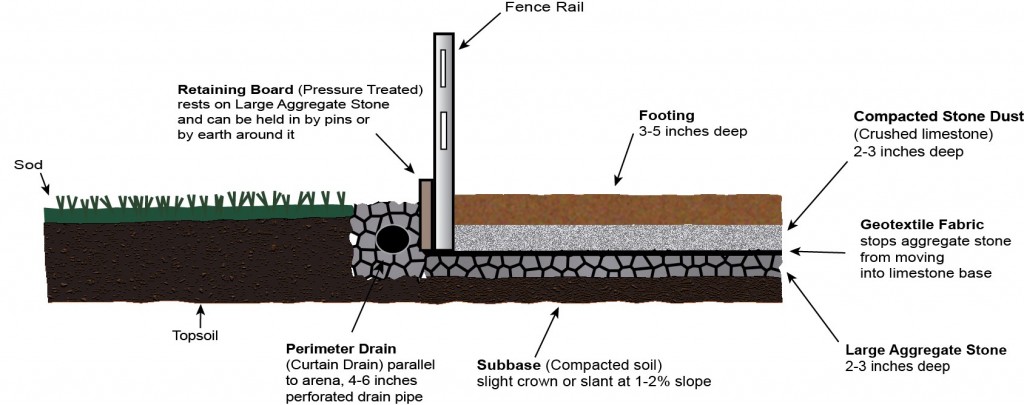
Just below, you can see a graphic of a side view of how arenas should look. Your base should be about 2-3 inches of large aggregate stones, with 2-3 inches of compacted stone dust on top of that. Your retaining board needs to sit on the outside of your fence posts, directly on top of the aggregate stone. The retaining board can be held in place by the aggregate stone drainage on the outside of the arena, or you can install pins in the boards to hold it in place. The top of the board should be about 1-2 inches above your footing in order to stop the footing from escaping the arena.Footing Side View
IGK Equestrian has spent years studying and researching the best ways to build both outdoor and indoor arenas. We have driven or flown out to see customers, whether an hour away or across the country many times to help them with the installation process of their arena, and we can come to your arena for a consultation at any time, just call us up or send us information online! Our dust-free footings are the perfect addition to your arena installation. With never having to water the arena and less time on maintenance, you have more time to ride and train your horses.

Is there something you wish you did differently when installing your arena?
Arena Footing: It’s Not Just About Feet.

April 1, 2013

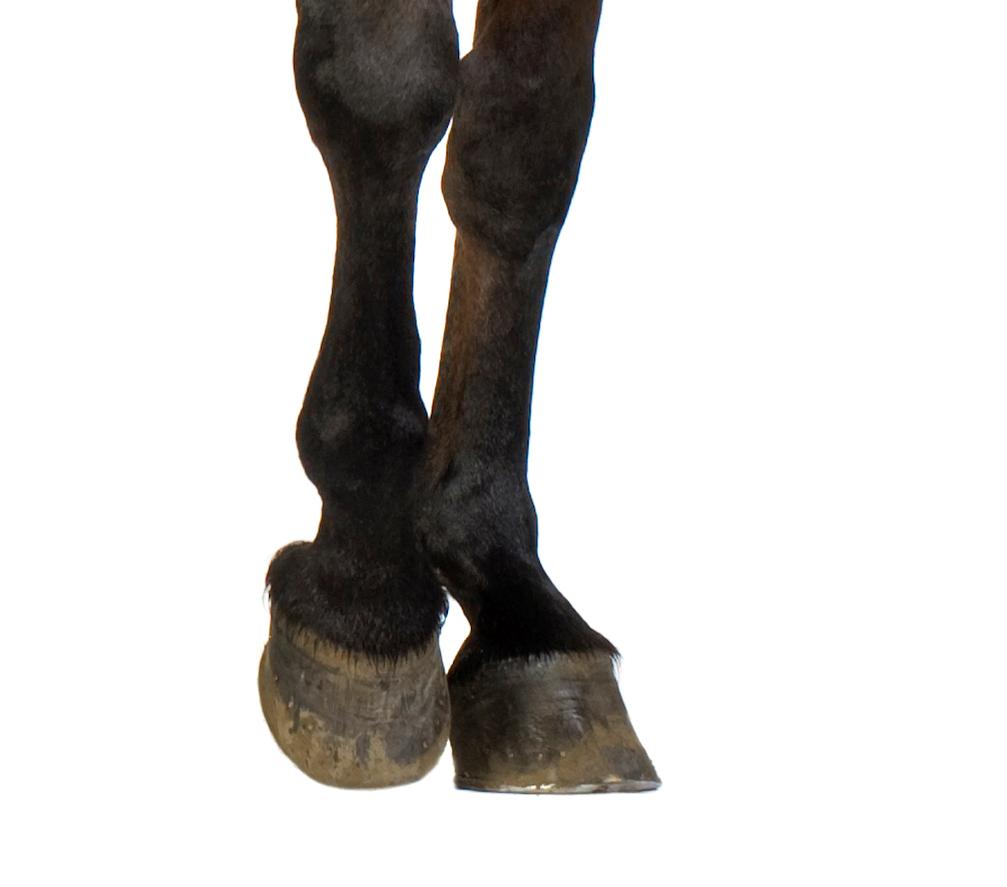
Arena footing may cause injuryArena footing isn’t just about the feet—but about the horse’s entire body. Arena footing influences the entire musculoskeletal system, including bones, muscles, joints, tendons and cartilage. Choosing the right type of footing is important because some surfaces can be a potential risk factor for injuries.

  • Coffin bone fracture is a common fracture among horses who ride fast on hard surfaces. When a material, such as clay or stone dust dries out, it compacts and forms a hard surface, causing horses to move stiffly. Since materials can compact over time, adding an amendment helps reduce compaction and can provide cushioning necessary for good leg and tendon support.
  • Degenerative joint disease (DJD) can be developed due to repeated shock impact of the hoof with the ground, which can lead to progressive and severe cartilage damage. Surfaces with lower-impact resistance absorb more energy and reduce shock to the hoof and leg. Sand has a lower impact resistance, but very deep or dry sand can lead to injuries other than those caused by impact shock.

Wax-coated sand, rubber and fiber arena footing materials can help reduce the shock of contact between the hoof and the surface. To help prevent the risk of developing tendinitis, fractures and joint injuries, be sure to train on a wax-coated footing surface like TruStride® or LiteStride® by IGK Equestrian. TruStride and LiteStride not only provide a stable, flexible and resilient riding surface, but are among the best footings to prevent injuries in the arena.

How do you prevent injuries in your arena?

10 Most Popular Posts on Carolyn’s Footing and Bedding Blog

March 12, 2013

Top 10 Arena Footing and Stall BeddingOver a year ago, I wrote my first post introducing myself as part owner of IGK Equestrian.  I created this blog so I could address some of the main challenges associated with arena footing and stall bedding and share success stories from people who have used the products. I’ve covered topics ranging from dust control in arenas to tips on how to “go green” in a horse stall. Here, in reverse order, are the 10 most popular posts to date on Carolyn’s Footing and Bedding Blog.

#10: Is Your Horse Eating in Bed? This post revealed horses on restricted calorie diets were ingesting wood shavings in their stalls. Typically, wood shavings aren’t a horse’s “go-to” snack, but when on a diet, bedding can look pretty tasty!

#9: Fuming Over Stall Odor. When drainage is poor, or stalls aren’t mucked out regularly ammonia fumes and bacteria can build up. This can be irritating and harmful for both horses and humans.

#8: The Link Between Sand Footing and Lameness. A study by the University of Glasgow showed the type of arena footing, specifically sand, can be a risk factor for lameness in dressage horses.

#7: Cutting Back on Bedding. Replenishing materials and mucking out stalls can be a hassle. This post suggests using a mat system with a waterproof top cover because it helps reduce the amount of bedding and disposal costs.

#6: Is it Time to Change my Stall Mats? If you are using a lighter- weight mat, you may have to remove it once a month to re-level the stall; however, with heavier mats, this may only be a semi-annual event.

#5: Horse Stalls can “Go Green” Too! At a young age we learned the 3 R’s: Reduce, Recycle and Reuse. This popular post proposes ways to make environmentally-friendly choices when it comes to your horse’s bedding!

#4: My Names Carolyn “I’m an Arena Footing Freak!” This was my first post introducing myself as an arena footing freak! From this point on I aimed to educate my readers about both arena footing and stall bedding.

#3: Dust Control in your Arena. Dust in the arena is common, and suggestions on how to control dust is a topic we’ve returned to time and again on this blog.

#2: How to Create a Safe Foaling Stall. A lot of people are searching the Internet for ways to create a safe foaling stall. Needless to say, quite a few of them are landing on this post.

#1: Solid Rubber Mat vs. Foam Mattress…Which is Ideal for Your Stalls? This informational post compared two popular types of stall mats. If it helped you make a decision, I’d love to hear from you!

Meet TruStride customer Nancy Rosen!

March 1, 2013

TruStride at Frog Hollow Farm

Nancy Rosen is the owner of Frog Hollow Farm, a dressage training facility in Esopus, NY. Nancy installed TruStride arena footing at Frog Hollow two years ago, and is happy to answer questions about her experience.

How did you hear about TruStride?

At the time I was doing a lot of reading about various arena footings out there, searching for an alternative to sand.

What made you choose TruStride?

I wanted a surface that would absorb the shock of hitting the hard ground but at the same time wouldn’t absorb the bounce that dressage needed. Ultimately, I didn’t want a footing that was dead. I needed a more lively surface. These factors lead me to TruStride and I’ve been extremely happy ever since.

What were you using before installing TruStride?

My former outdoor arena was made up of a combination of stone dust and sand. I’ve tried many materials over the years but I couldn’t find a footing that gave me everything I wanted. The indoor facility was initially made up of composted manure but it created a lot of dust. So I tried switching to sand, which was also dusty and it didn’t have enough bounce—it just absorbed all the energy. That is why I’m so glad I came across TruStride. I ended up building it on top of the dormer outdoor arena and it is now the footing in the indoor facility.

Have you noticed a difference?

TruStride has made a huge difference in the arena. The horses really move well on it and the riders love it, too! TruStride absorbs harshness in the stride which makes the horse’s movements feel so much softer.

Anything else?

The people at IGK Equestrian are wonderful to deal with. They are very responsive and easy to get a hold of. Every now and then I will call to ask if they can tweak the footing a little bit and they always do it. I have been extremely pleased with my experience. In fact, I just recommended them to someone else!

For more information on TruStride®, Dust-Free Arena Footing, visit IGK Equestrian.

IGK Arena Footing Ads Win Big!

January 31, 2013

IGK Arena Footing AdI am thrilled to announce two of IGK Equestrian advertisements, created by LP&M Advertising, were among the winning entries in the regional “Best of NAMA” competition for the  National Agri-Marketing Association!

For those who don’t know, this specific award show honors excellence in marketing communications for the agriculture and animal health industries. Our ads were placed in the regional competition which featured entries from agri-marketing agencies throughout the northeast United States and mid-Atlantic. Both ads displayed horses resorting to extremes to avoid dust caused by sand arenas.

Wish us luck as the entries will now advance to the national Best of NAMA competition in April!

Arenas Can “Go Green” Too!

November 9, 2012

Arenas Can "Go Green"My last post, Horse Stalls Can “Go Green” Too was such a hit, I decided to write another on how environmentally-friendly choices can be implemented in your arena!

Arenas can be dusty places, and the most common method of controlling dust is through watering. The key is to water heavy and seldom, rather than frequent and light for the best results. However, in large arenas you could be using up to 3,500 gallons of water a day just to keep dust under control. Switching to a dust-free footing can conserve thousands of gallons of water each week and is a great way to help your arenas to “go green.”

Another option to consider is installing footing made of recycled materials. Look for dust-free footing comprised of ground up rubber shoe soles, tire buffings or other recycled rubber/fiber materials.

TruStride, a Dust-Free Arena Footing by IGK Equestrian not only eliminates the need for watering—ever—but it greatly reduces maintenance. Its environmentally-friendly combination of recycled rubber, silica sand and synthetic fibers provides a flexible and resilient riding surface making it a popular choice among arena owners worldwide.


How do you practice “going green” in your arena?

The Link Between Sand Footing and Lameness

October 10, 2012

Sand Footing and LamenessNeed another reason to avoid sand arena footing? How about lameness?

A recent study by the University of Glasgow showed the type of arena footing can be a risk factor for lameness in dressage horses. Researchers surveyed registered members of British Dressage to investigate relationships between surface footing characteristics and the likelihood of lameness. They found that woodchips were strongly associated with slipping and sand with tripping. The least problematic surfaces were those that were wax coated and those that were a combination of sand and rubber.

In a recent article on this study, The Horse suggested one explanation for the results is the unevenness of sand and woodchip surfaces, in both wet and dry conditions.

Horses are more likely to trip on coarse sand because it is easier to lose balance and they are nearly 13 times more likely to slip on woodchips than any other surface, according to the article.

To minimize slipping, tripping and lameness, be sure to train on a wax-coated footing surface like TruStride® or LiteStride® by IGK Equestrian. In addition to providing a stable, flexible and resilient riding surface, both footings eliminate dust and the need to water—yet another advantage over sand arenas.

How do you reduce trips and slips in ­your arena?

Dust Control in your Arena

July 26, 2012


Have you noticed your arena is dustier than usual? You’re not alone. Arena dust is more apparent in the summertime, especially with the hot, dry weather we’ve been experiencing lately. Riding just exacerbates the problem because the more you ride, the more your footing breaks down, eventually becoming airborne and creating dust.

Constant inhalation of dust can cause serious respiratory problems for horses and riders. Here are some ways to reduce and sensibly manage dust in your arena for everyone’s safety.

1. Water: The most common method of controlling dust is through watering. The key is to water heavy and seldom, rather than frequent and light for the best results. Watering is cost-effective, readily available and highly effective if done properly. However, in large arenas you could be using up to 3,500 gallons of water a day just to keep dust under control.

2. Salt: Another common dust suppressant is the addition of salts to your footing.  Salt additives work best in high humidity because they draw moisture from the surrounding area, which helps to effectively suppress excess dust. The downside of this tactic is that eventually the salt will wash away making reapplication a constant nuisance.

3. Wood: An additional buffer that helps to control dust in the arena is wood shavings or pieces.  Wood helps to slow the breakdown of sand while also helping your arena retain moisture. After some time, just like salt, the wood pieces will break down, but with regular watering you should be able to minimize dust for an extended period of time.

4. Footing: The best way to combat dust in your arena is to eliminate it altogether.  This can be easily achieved by using a dust-free footing, such as TruStride® or LiteStride®, manufactured by IGK Equestrian.  These arena footings eliminate the need for watering, reduce maintenance requirements and provide adequate support for both horse and rider.  Did I mention both TruStride® and LiteStride® are dust-free and reasonably priced? Now that’s a long-term investment sure to minimize dust and maximize riding potential in your arena.

How do you effectively manage dust in your arena?

Respiratory Issues In The Ring

June 4, 2012

I recently came across this article in The Horse on clinical signs of common respiratory issues in performance horses. Most of us are already vaccinating against influenza, herpes virus and other equine respiratory diseases, but plenty of other conditions can interfere with breathing and cause under performance in the ring. According to the author, Dr. Jean-Yin Tan, up to half of performance horses have been affected by Inflammatory Airway Disease or IAD, a condition that causes coughing, nasal discharge and exercise intolerance. Dr. Tan cites dust as a leading risk factor for IAD.

That’s a real problem in sand arenas, where dust is an ever-present, environmental nuisance. Owners of these facilities go to a great deal of trouble and expense to keep sand from erupting into a dangerous respiratory threat to both horses and riders. The usual remedy is water, and lots of it — up to 3,500 gallons a day — just to keep dust under control.

Of course, the easiest way to rid your arena of dust is to install dust-free footing. Both TruStride® and LiteStride® arena footing by IGK Equestrian eliminate the need for watering while providing a supportive and responsive riding surface. And that makes everyone breathe easier.

What kind respiratory issues have you experienced in your arena?

Top 4 Signs Your Arena Footing May Need an Amendment

May 7, 2012

The ideal arena footing would be cushioned enough for horse comfort with the right amount of traction while causing minimal dust and hoof abrasion. However, ideal conditions are not attainable without proper maintenance.  Achieving appropriate conditions in your arena may require adding an amendment to improve the riding surface for your horse. Here are some signs to watch for:

4. Too Hard: Arena footing materials can compact over time.  Adding an amendment can provide cushioning necessary for good leg and tendon support.

3. Too Shifty: Footing that suddenly shifts underfoot can rattle even the most seasoned horse and rider.  An amendment can add valuable stability.

2. Poor Recovery Surface: Footing that leaves deep tracks or fails to bounce back after use could probably benefit from an amendment.

1. Horse Refusal: Any or all of the above issues can result in a balky horse.  If your horse is reluctant to enter the ring, it may be time to consider an amendment.

Common arena footing amendments materials include rubber, wood chips, or fiber materials. SoftShoe® is an ideal composition of recycled fibers and rubber that provides superior cushioning and stability which resists packing over time.  It can be easily installed with existing footing or in new arenas.  It is an optimum amendment to help keep your arena footing fresh and your horse happy.

What are some additional signs that your arena may require an amendment?