Oops, I Spilled Water in My Stall!

November 23, 2015

I’ve helped out at a lot of different barns over the years. I like seeing exactly how everyone operates their facility and has their own particular ways. But no matter what, when I am in a barn and I am filling water buckets they always say “don’t let it overflow!!”

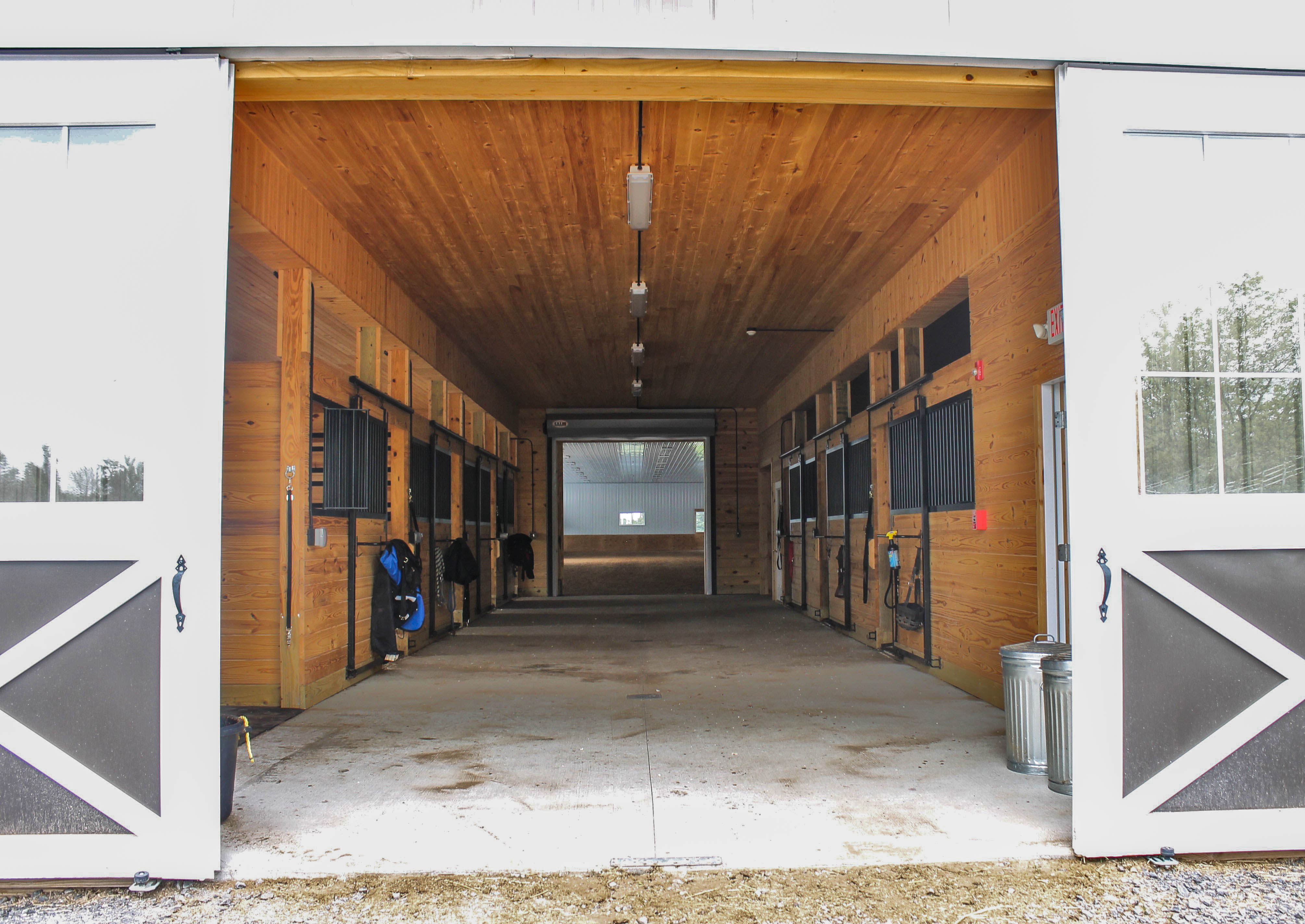
If you have a deep bedded system, the spilled water will create a big wet area, and you normally spill it right where the water bucket is, where the horse stands most of the time. Some barns will leave the water in the stall, and wait for it to eventually evaporate.  It is not good for your horse to stand in wetness for long periods of time. Too much moisture in the horse’s hoof will actually weakHunter Harrison 037en and break the hydrogen bonds that are in the cellular makeup of the hoof, and will make the hoof too flexible and reduce the hoof’s structure.  The hoof will become soft and weak. Other barns will pull out the three inches of bedding that it saturated and replenish that whole area with new bedding, becoming very costly. If you’re using thick rubber mats, this water can get under the mat and create mold; which is dangerous for your horse to be around.
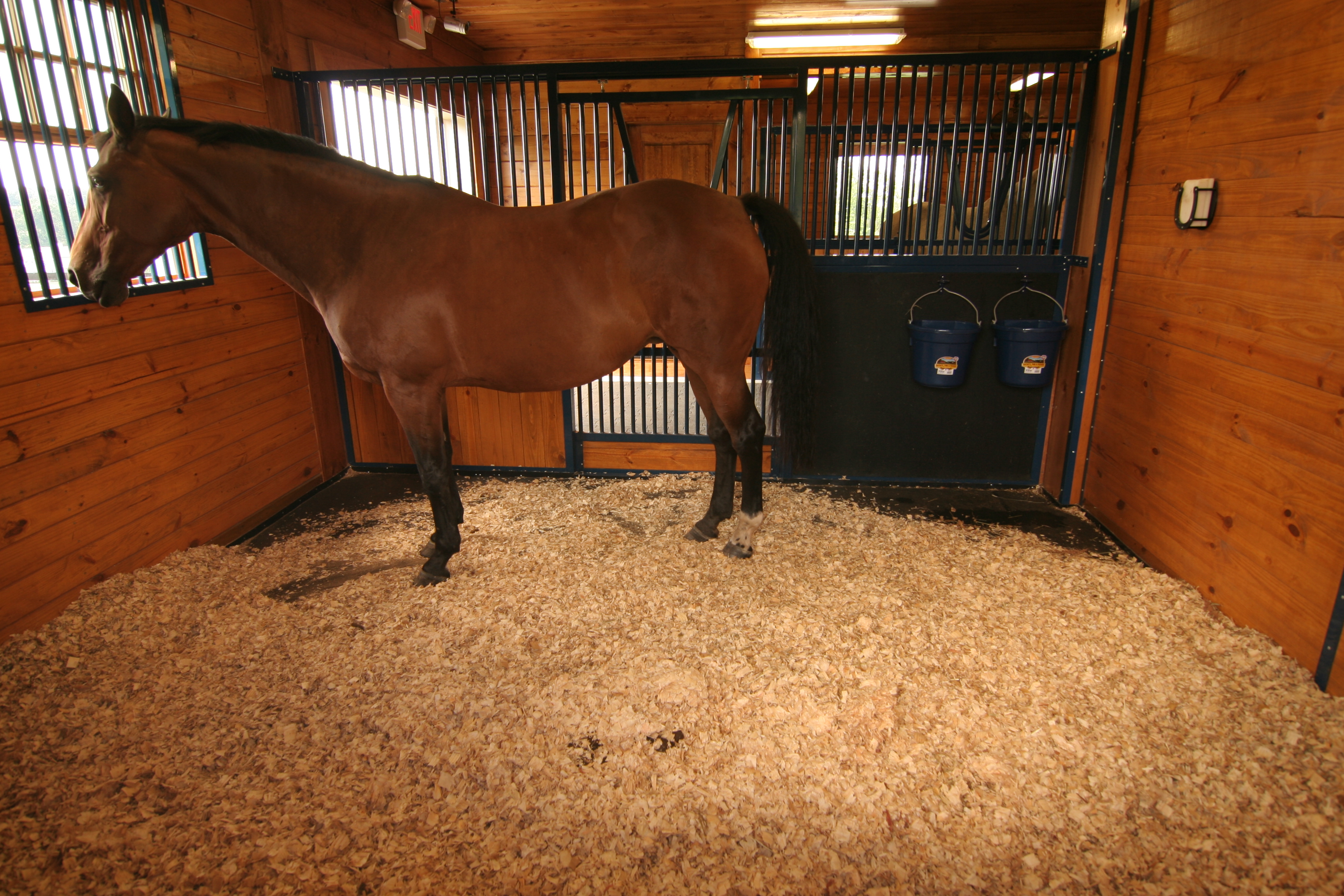
If you were to have a SuperStall Mattress System in your stall, then spill some water, it is an easy clean  up! Our SuperStall Mattress keeps all liquids right on top of the rubber topcover. The topcover is not porous so you don’t need to worry about the topcover absorbing some water and creating bacteria, and water will not get under the topcover and create mold. You only need to bed your stalls about one inch, so you don’t have to worry about having your bedding being soaked. Most people with our stalls installed, just shop vac up the water that is sitting right on top of the cover and add a bit of refresher bedding. You’ll never have to tell your barn help “don’t let the water overflow!!” again!


Stall Floors

November 9, 2015

You would not believe the kind of questions I get during sales calls for our SuperStall Systems. How old is your oldest stall? (Our first one was installed in 2006!) How thick is your foam pad under the topcover? (1 1/8”) How thick is the full mattress system together? (Around 1 1/4”) The next question I normally get is “what flooring should be under the mattress system?”

When building a barn, you normally have a subgrade (your soil), then 2-4 inches of a subbase, composed of aggregate stone, and then 2-4 inches of a compacted crushed stone, such as limestone. There are a variety of floors that you can have in yourIMG_2205 barn. Some choose to keep this crushed stone base as the floor of their entire barn, some pour a cement center isle while keeping crushed stone in the stalls, while others will pour a cement floor inside the entire barn. Pouring cement in the entire barn, or at least a cement center aisle are the best options for horse owners. If you for some reason cannot pour any cement, there are ways to make crushed stone work. The most important thing when utilizing a crushed stone floor is to make sure that it is fully compacted. If you are using crushed stone as your entire floor, you will most likely disrupt only the top 1/2 inch in the aisle way. Everything under that 1/2 inch will not be disrupted if it has been compacted correctly. Both cement and crushed stone are not adequate enough for a stall floor. There should be some sort of barrier between your horse’s hooves and the hard surface. Think of how much our bodies hurt from standing on concrete all day, a horse is the exact same. They don’t want to stand or lay on a hard surface, and adding extra bedding for padding is not much help. The stall requires some sort of cushion for the horse.

Our SuperStall Mattress System works great with both crushed stone floors and cement floors. IGK SuperStall system is composed of foam and a rubber topcover. The foam lie
s directly on the floor, while the topcover is installed over the foam and attached to the stall walls, sealing the foam under a waterproof surface. When you have a crushed stone floor, we recommend that you have a plastic sheet under the foam, so the moisture that sometimes works its way up through the crushed stone, does not reach the foam. If you have any other questions that you would like me to answer in a blog please let me know!

SuperStalls Can Help You Go Green Too!

November 3, 2015

Horse Stalls Going GreenLast week I focused my weekly blog on how our footing can help your barn to “Go Green”. This week we’re going to continue the discussion and focus on our SuperStall Mattress Systems. Our SuperStall Mattress system is a wall to wall mattress consisting of foam and a topcover. The topcover attaches to the wall and seals off the foam mattress, creating a barrier so that no liquids can get to the foam. Our durable topcover keeps liquids on top and your horses happy. Since our SuperStall has the perfect amount of cushion, you don’t need to add three inches of bedding to give your horses more cushion, instead you only bed your stall at the most, one inch. When using less than an inch of bedding, you will be saving up to 60% in bedding. This not only saves in time and money, but in the environment too!

In our last post I spoke of composting your manure. By composting your manure, you will be able to recycle the manure and use it on your gardens or to fertilize pastures in the spring.  When you fertilize your pastures with compost, you are improving aeration and also water retention by creating healthy soil in your pastures. Composting your manure not only reduces your waste and improves soil quality, but reduces flies in your barn and can kill parasites and pathogens.  In addition to composting your manure, think about ordering your bedding in bulk. You should get a discount for ordering a larger amount and you’re also cutting down the amount of gas used to pick up or deliver. If you don’t think that you will use an entire load of bedding for your barn, perhaps think of a neighbor that would be willing to split the load with you. These are just a few options to make your barn more environmentally friendly.

What do you do to keep your barn environmentally friendly?

Our Footing Can Help You Go Green!

October 26, 2015

Farms all around the country have been working harder and harder to “Go Green”.  Both horse farms and dairy farms are focusing on how to minimize their impact on the world around us. Dairy farms for examples often times use digesters that recycles their cow manure into electricity that runs their entire farm. Horse farms can do their part in trying to “go green” too!

A few tips that can help your farm become more environmentally conscious:

  • Make sure your hoses or faucets around the farm don’t leak.
  • Compost your manure
  • Harrow your pastures to break down manure and spread it out for the grass to utilize the organic material
  • Plant a water garden here the rain runoff from your barn runs to, these are plants that help soak up water

Our dust free footings for horse arenas are a great start to helping your farm go green. I recently wrote a blog about what our footing is composed of. Here’s a recap. The rubber in our footing is 100% post-industrial waste that we recycle. It comes from a factory that makes shoe soles, and we take the scraps or what is left over from the molds of the shoe soles. Our fiber blend in our footing is also 100% post-industrial waste, these also come from a factory that would have otherwise thrown them away. Both the fiber and rubber would have sat in landfills, taking hundreds of years to break down. The components that we choose to create our footing with, we choose with the environment in mind.hand-157251_1280

Additionally, our footing is dust free. You will not need to water your arena, ever! An average sized arena could use up to 3,500 gallons of water per day to adequately keep moisture level in the 20% range. Think of how much water you can save by switching to our footing, not to mention time spent watering! Stay tuned for next week’s blog on how your horse stalls can become environmentally too!

Options for Horse Stall Bedding

October 19, 2015

Let’s talk about options for horse stall bedding. The options for bedding in your horse stall are pretty endless. In the end you have to choose something that your horse loves and it works great with you too. Bedding should have a few characteristics in order to dub it the best bedding for both you and your horse. The number one thing is that it should be safe for your horse. Don’t try and experiment with random substances in your stall. Ensure that whatever you have in your stall is going to not harm your horse externally or internally in any way, and should also not be dusty. Whatever material you choose should be absorbent (which is kind of the whole point of stall bedding), and easily composted. Your material also needs to be readily available. If whatever material you choose can be compacted, that can immensely help when looking where to store it in the barn. Most importantly, it should be cost-effective and easy to pick manure from so that you don’t spend hours a day mucking your stalls.IMG_2206

Now that we’ve discussed the criteria for horse bedding, let’s take a look at some options.

Option #1 and most popular: Shavings.

This option can be the most economical based on where you live. For example, where we are located in Upstate NY it is very easy to get ahold of wood shavings for stalls. It is cheap and you can often buy in bulk. It is easy to store and is very absorbent. The only downfall of this option is that it can be very dusty, and can even make your entire barn dusty. You should have good ventilation in a barn where loose shavings are present to give your horses fresh air. Some barns that I have gone to keep their shavings stored in a lean-to on the outside of the barn.

Option #2: Wood Pellets

I really think that this option is becoming much more popular in recent years.  Wood pellets are made of kiln dried wood and sawdust. The kiln dried wood and sawdust is compressed into a small pellet. When this pellet is in the stall and moisture hits it, it will expand to be normal sawdust again and is as absorbent as regular sawdust. This option is low in dust from the compression process and is packaged in bags, so it is easy to store; and is relatively inexpensive. The only issue with this type of bedding is that you will need to spend a little extra time to make sure that you don’t take out any pellets when you muck the stall.

Option #3: Peat Moss

Peat moss is an option that is easily available and horses seem to like it a lot because it gives them that soft bedding to lie down on. You can find this at your local hardware or garden store and a little bit goes a long way so you only need to buy a few bags. It is absorbent in the stall and virtually dust free! The only downside is that if you have a barn with many stalls, this is not your best economical option. It can get expensive for many stalls.

Option #4: Straw

Straw has been used in stalls since the beginning of time. It is often inexpensive and can be easily obtained. If it is mucked properly it stays pretty clean and composts very well. But there are many cons to straw. It is not very absorbent, (which kind of defeats the purpose of stall bedding) it requires a lot of room to store the bales, and can be very dusty. Another note to keep in mind is that some horses do try and eat this. You will need to keep an eye on what horses eat this bedding and possibly change their diet based on that.

No matter what type of bedding you use, if you have SuperStall Horse Mattresses in your stalls you will save tremendously on bedding. Our SuperStall System needs less than an inch of bedding, which will then make mucking your stalls out much easier! If you want to save on bedding, call us today for a sample of our stall mattress!

Correct Footing for Horse Disciplines

October 12, 2015

Horse disciplines are all so diverse. There’s reining, barrel racing, jumping, grand prix jumping, dressage, endurance, polo, eventing… should I go on? Each discipline asks the horse to do different things and the horse has been trained long and hard to accomplish ever command the rider asks. With each discipline being so diverse, so should the footing for the disciplines.

When you’re a barrel racer, and trying to cut milliseconds off of your run each time, every little aspect of your ride matters.  If you’re riding on a hard ground, your horse isn’t going to be able to slide around the barrels. He’s going to have to work hard to grip the hard ground and turn faster. Now let’s say that you’re jumping your horse, performing some high grand jumps, around 5-6 feet (this is great pretending we can jump that high). If you’re jumping your horse this high and landing on a hard surface, your horse could get seriously injured from landing on a hard surface. The surfaces that you ride your horse on, makes a huge impact on how your horse feels, continues to train, and performs.

Our TruStride Footing, is designed specifically for the high jumps that we just discussed. The footing is composed of rubber, synthetic fiber, wax, and pure silica sand. The rubber works hard to create that bounce back effect that a horse needs when jumping such heights, while the fiber forms a lattice-like surface and the wax makes the footing dust free. It is also great footing for Thoroughbred Tracks, allowing race horses to spring off of the surface and forward in their race.

Our LiteStride Footing is the perfect footing for various disciplines such as dressage or hunter/jumper. LiteStride consists of synthetic fibers, wax, and pure silica sand. The fibers make the perfect surface to support your horse while training for dressage and going over smaller jumps; allowing the surface to “give” a little while still staying resilient.

The newest product of footing: Equi-Blend is our most economical option. The formula for Equi-Blend was constructed with the average barn owner in mind. We wanted a footing that everyone could afford while still staying dust free. This footing is recommended for a variety of disciplines such as dressage, Western/Pleasure, or small jumping at a low traffic barn. If you Frog Hollow (14)- Editedare doing higher jumps or it is a higher traffic barn, we would encourage you to consider our TruStride footing.

5K Ranch was developed specially for western riders. It is perfect footing for flat work, loping, cutting, and barrel racing. This is a looser footing that is only used with western pleasure. It consists of our pure silica sand and wax. It stays dust free while still allowing for the “slide” in the footing that is needed in a discipline such as reining.

No matter what discipline of horse riding you train long and hard in, we have the perfect footing for you. Send us some information about your arena and we can suggest the right footing for you and send you a sample!

What is your favorite discipline?


Breaking Down the Recipe of our Footing

October 5, 2015

We get many questions about what our footing is made up of so I thought I would take a few minutes and explain the components of our footing and why we use such components. Each of our footings has their own special formula. (I’m not going to give you the secret recipe though, sorry!) Let’s take a look at what’s inside.

Our TruStride footing is composed of rubber granules, synthetic fiber blend, wax and pure silica sand. LiteStride is made up of a synthetic fiber blend, wax and pure silica sand. The new Equi-Blend footing has the same components as LiteStride, but less fibers and less wax, which minimizes the cost. And our 5K Ranch footing is composed of pure silica sand and wax.

Let’s start with explaining our rubber granules. The rubber comes that we get comes from a factory that manufactures shoes. When shoes soles are created, there is a mold that they are in, once the shoes soles are cut out, there is excess material that is considered a waste to this factory. This waste is ground up and delivered to us as small rubber granules, making this 100% recycled post-industrial material. We chose to add rubber granules to our TruStride footing to give it the extra cushion needed for high jumping disciplines, busy barns, or thoroughbred tracks.

Our synthetic fiber blend that we use is made up of premium recycled fibers also making this ingredient a 100% recycled post-industrial material. We chose to use synthetic fibers because they do not break down over time. The fibers in our footing create a lattice like effect, holding the footing together and allowing it to “give” a little while still creating a stable surface.

The most important components of our footings, and what keeps it dust free is our wax that we use. There are plenty of otherIMG_0897 options that are used in footings to coat the material and keep it dust free, both natural and synthetic.  The logic behind this choice was the longevity of wax. Our oldest footing is 14 years old and is still going strong. Wax does not break down and decompose like other binders.  It is a top of the line wax that we have never had a problem with and love working with!
The pure silica sand is the last but not the least. We have spent a lot of time finding the perfect sand for our blend. The sand that we chose is subangular sand. Normal sand has lots of different shapes and angles. When this type of sand is put into an arena, the sand angles on the sand particles will eventually be worn down, creating dust in your arena, and also causing your surface to not be as stable as it once was. Subangular sand has been partially worn down so that there are some small angles but most of it is rounder. By using sand like this, the smaller angles allow the sand to get nice and tight together while still allowing room to move. It creates the perfect stability that we wanted for our footing.

We’ve spent many years in research and development before we came to have the perfect recipe for our footing. That’s why our footing is the best dust free footing on the market! Feel free to contact us and ask for a sample so you can visualize the different components that are used.

Picking up Manure in Horse Arenas

September 29, 2015

We love to catch up with customers. If we are in the area of where we know an arena is installed, we always like to see if we can stop in and check out the arena. I talked to a customer the other day that has had our footing for 9 years, and still tells me how much she loves it! Think of all of the time and water she has saved during the past 9 years!

One of the biggest mistakes that many of our customers make is to not pick up their horse manure in the arena. Many people don’t know this but leaving horse manure in an arena, actually adds dust. Manure is made up of organic material. When manure is left in an arena and is ridden over, it breaks into smaller pieces. Not only do these smaller pieces release airborne bacteria, but it also releases the dry particles that create dust. We had one customer who had our dust free footing in her arena, and her boarders were leaving their horse poop in the arena when they rode. She contacted us because her arena footing became dusty. After viewing the footing under the microscope, we discovered that it was full of organic material and there really was no way to fix the arena without completely removing the contaminated footing and replacing it with new footing.Untitled-1

Being sure that both you and whoever else rides in your arena picks up their horses manure is crucial. We recommend that every barn with our footing post signs around the arena that reminds boarders or trainers that the poop has to be picked up. We also urge everyone to keep a bucket with a pitchfork in the arena to further remind everyone to pick up their manure, and to stop anyone from having an excuse from picking it up. Whether riders pick it up immediately after the horse does their business, or after they’re done riding is not an issue. If they decide to wait until they are done riding in the arena or there is a busy class going on and don’t have time to pick it up during the class, it is important to not ride through the manure during the rest of the ride or lesson. When a horse rides over it, the manure will be pushed deeper into the footing, making it almost impossible to pick up without accidentally leaving some behind.

Always picking up the manure is going to increase the longevity of your arena. Our oldest dust free footing was installed in an arena over 14 years ago and is still doing great! If you have any questions about the maintenance of our footing or would like a sample please feel free to contact us!

Retaining Boards in Arenas

September 21, 2015

Let’s talk about outdoor arenas. What is your biggest issue with your outdoor arena? Outdoor arenas are trickier to build and maintain than an indoor, for the fact that you are working against Mother Nature. An all-weather horse arena needs to be designed and constructed to deal with the many different weather conditions that Mother Nature may send your way. Having a traditional sand arena during these situations can make the fight even harder.

I think there are many aspects of outdoor arenas that are overlooked when building, then by the time you are done you wished you had done something differently. One of the biggest, minor things that I think is overlooked is the importance of retaining boards in an arena.

Retaining boards are very critical to an arena. They have the job of holding the footing in the arena, and stopping it from migrating into the drainage outside of the arena or grass. Many times, without using a retaining board, footing is pushed to the outside every time the arena is groomed. During this instance, customers have to replenish their arena every few years because of footing loss into their yard. Along with keeping the footing in the arena, retaining boards also create a nice clean boarder around the arena. This will stop grass from growing in the arena, and make it easy to maintain and mow the area around it.

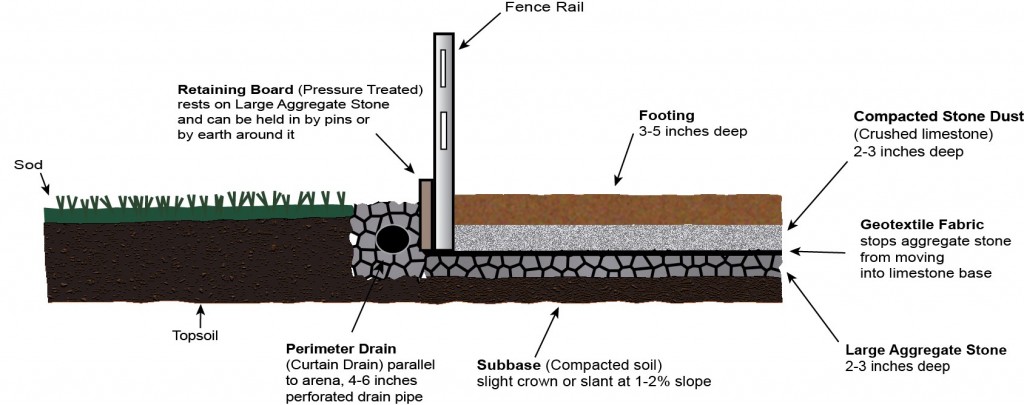
Just below, you can see a graphic of a side view of how arenas should look. Your base should be about 2-3 inches of large aggregate stones, with 2-3 inches of compacted stone dust on top of that. Your retaining board needs to sit on the outside of your fence posts, directly on top of the aggregate stone. The retaining board can be held in place by the aggregate stone drainage on the outside of the arena, or you can install pins in the boards to hold it in place. The top of the board should be about 1-2 inches above your footing in order to stop the footing from escaping the arena.Footing Side View

IGK Equestrian has spent years studying and researching the best ways to build both outdoor and indoor arenas. We have driven or flown out to see customers, whether an hour away or across the country many times to help them with the installation process of their arena, and we can come to your arena for a consultation at any time, just call us up or send us information online! Our dust-free footings are the perfect addition to your arena installation. With never having to water the arena and less time on maintenance, you have more time to ride and train your horses.

Is there something you wish you did differently when installing your arena?

Barn Hacks For Your Barn

September 8, 2015

Running a barn is a lot of work. Whether you have IMG_2205a lot of help or not. It can be easier with different tips and tricks that you can use around your barn. I’ve pulled together a nice list of a few “barn hacks” to make your life at the barn easier!

  • In the summer, freeze gallon jugs of water and throw them in your outdoor water buckets to keep the water cool for your horses.
  • Put your feed and hay in a central location in your barn so that you’re not running to one end of the barn every time you have to feed someone.
  • Mount a bucket horizontal with the opening facing out where your hose is, you can wrap the hose around the bucket for organizing your hose, and the bucket serves as a perfect spot to store your nozzles, brushes and soaps for giving your horse a bath!
  • If your horse likes to drag his bedding out into the isle, install broom bristles at the opening of his stall, it will keep the bedding in.
  • The most annoying noise to me is when you drop a cross tie and it clinks against the wall, I’ve even had horses scare from this noise. To help this issue cut a tennis ball on both ends to slip the cross tie through, it won’t make any loud noises when you drop it!
  • Install a PVC pipe near an indoor or outdoor arena to hold your various whips. If it’s outside just make sure to drill a hole in the bottom so that water can get out.
  • Colored duct tape is a great way to distinguish everyone’s supplies, just tape the handles of grooming supplies. Everyone gets their own color or their own pattern.
  • Use shoe organizers in your tack room to store all of your polo wraps and boots either in the barn or in your trailer. Grab a larger clothes hanging organizer to store helmets!
  • A pool skimmer comes in handy when trying to clean out your horses water bucket, quickly use it to grab debris that’s in both your outdoor water buckets and stall buckets!
  • During the winter time, hang your bridle around your neck, inside your jacket to warm it up for your horse, they’ll greatly appreciate a warm bridle and bit!

I would love to hear any other “barn hacks” that you may have in the comments below!